GO Raid Party - Worldwide Raid
- 4.8
- Rating
- 500.00K
- Installs
- Free
- Price

 Analysis by App-foxy
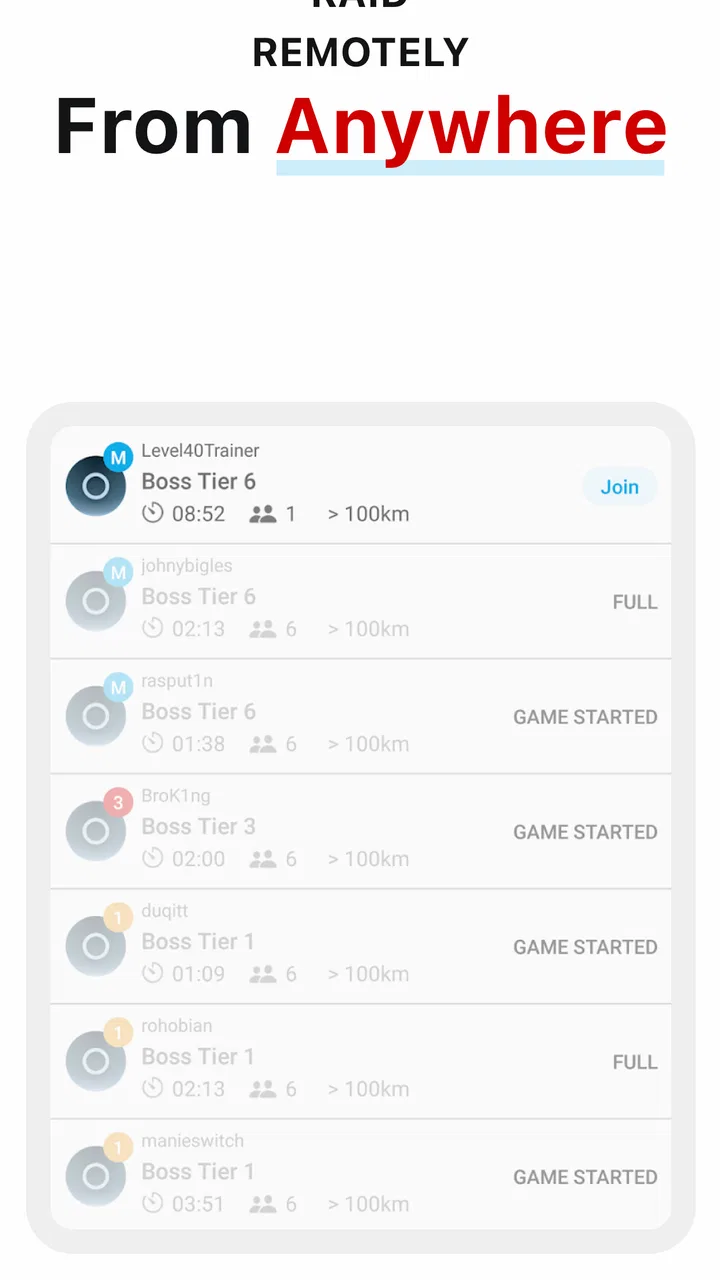
I found GO Raid Party - Worldwide Raid most useful as a quick coordination tool for Pokémon GO players who want to join a remote raid without spending a long time searching for a group. The basic promise is simple: open the app, find an available raid, and get moving quickly. In my experience, that narrow purpose is also its biggest strength. It does not try to become a complete Pokémon GO companion, so the experience feels more focused than using a general chat group, social network, or a broad collection of raid tools.
This is a free tools app from Tiny Whale Pte. Ltd., rated for Everyone. It has built a strong audience, with an average rating of 4.8 from around 28 thousand ratings and more than 500 thousand installs. Those figures suggest that the central workflow works well for many players, but they should not be mistaken for a guarantee that every raid will be equally smooth. Your experience still depends on the available rooms, your connection, the timing of the raid, and how comfortably you can manage the app alongside Pokémon GO.
How GO Raid Party works in everyday use
I find the key to using this kind of raid coordinator comfortably is to decide what you need before opening it: a group for a particular raid, or just a quick look at what is available. That small distinction helps me avoid joining in haste and gives me time to check whether I can follow through. Next, I’ll look at how that focused approach plays out during an ordinary raid session.
You May Also Like

 Google Keep - Notes and lists
Google Keep’s Quiet Growth Shows the Appeal of Simpler Notes
As mobile work gets busier, Google Keep keeps winning a simple contest: capture a thought quickly, find it later, and get on with the day.

 Blood Strike: 2.5 Anniversary
Blood Strike’s Loadouts Turn Every Drop Into a Tactical Gamble
A close look at Blood Strike’s custom loadouts: how fast access to signature weapons reshapes its battle royale rhythm, rewards preparation, and narrows the gap between fights.

 Pandora - Music & Podcasts
Pandora’s Music Is Easy to Start, but Harder to Recover
Pandora’s strength is its low-effort path from a seed to a station. Its weak spot is how much confidence it asks you to place in connection, setup, and quiet recovery.

 8 Ball Pool
 Is Built on Rivalries, Rematches, and Routine
A close look at the rivalries, rematches, shared routines, and unanswered safety questions that turn a quick pool match into a persistent mobile community.

 Samsung Music
’s Quiet Strength Is Playing What You Already Own
Its reach comes less from spectacle than from dependable access to a personal library. That simplicity is both the app’s strongest retention engine and its ceiling.

 AccuWeather: Weather Radar
AccuWeather Review: A Quick, Clear Forecast for Everyday Decisions
For everyday plans, the best forecast is the one you can understand quickly. AccuWeather makes rain timing, radar, and local conditions easy to act on, with a few trade-offs.
More From Our News Desk



Readability and navigation come first
The first thing I noticed is that the app is designed around speed rather than exploration. That matters because a raid invitation is often time-sensitive. I do not want to open several menus, create a profile, or learn a complicated system before I can understand what is happening. A focused raid list is easier to approach than a large community platform where raid posts can disappear among unrelated messages.
The clearest way to use it is to treat the app as a short sequence. I open it, look for a raid that fits my timing, join the relevant party, and then switch back to Pokémon GO when the host is ready. That workflow is more practical on a phone than copying information from a busy chat feed. It also makes the app approachable for someone who has never used a raid coordination service before.
For a new user, the important habit is to read the room information carefully before joining. A visible raid is not automatically the right raid for you. Check whether the timing works, whether you can respond quickly, and whether you have the required in-game access ready. The app can reduce the effort of finding a group, but it cannot remove the need to pay attention to the game itself.
I also appreciate that the app’s purpose is immediately understandable. It is not trying to teach Pokémon GO strategy, manage a full collection, or replace the game. That narrow design helps readability because there are fewer reasons to wander through unrelated sections. Someone looking for a complete raid calculator or a detailed team-building tool may find the experience too limited, but someone who mainly needs a group can understand the value quickly.
The current version is 1.8.37, and it runs on operating systems from version 7.1 onward. That gives it a relatively broad reach among older Android phones, which is useful for players who do not upgrade devices frequently. Still, operating-system compatibility is only one part of practical access. Screen size, text scaling, touch accuracy, battery condition, and the ability to move between apps can make a bigger difference during a live raid.
Motor and sensory considerations during a raid
Raid coordination can be demanding for people who find rapid tapping, small controls, or frequent app switching tiring. In this kind of workflow, the challenge is not just understanding the information. You may need to select a room, respond at the right moment, leave the coordination app, open Pokémon GO, accept an invitation, and prepare your battle team. I found that the app is easiest to use when I prepare as much as possible before joining a party.
My practical advice is to keep Pokémon GO ready before searching for a raid. Make sure the game is already signed in, your raid passes are available, and your team is not completely unprepared. This reduces the number of rapid actions required after a host sends an invitation. It is a small change, but it makes the experience more manageable for anyone with limited dexterity or who simply dislikes hurried phone interactions.
For users who rely on larger text or display magnification, the most important test is whether the raid details remain understandable without forcing constant zooming or awkward horizontal movement. I would check the app on your own device rather than assuming that a comfortable layout on one screen will feel the same on another. The app’s straightforward purpose helps, but a compact phone can still make time-sensitive information harder to scan.
Sensory comfort also varies. A raid service can create pressure through changing availability, countdowns, notifications, and the expectation of an immediate response. If that atmosphere is stressful, I recommend browsing first without committing to a room. Learn how the information is presented, decide how much time you need to react, and only then try a live raid. That approach is less demanding than learning the interface while a group is already waiting.
Players with hearing-related access needs should not rely on sound alone when deciding whether a raid is ready. I would keep an eye on the app and the game rather than waiting for an audio cue. Likewise, anyone who finds bright screens or visual clutter uncomfortable may prefer a quieter time of day and a lower-pressure raid. The app can help locate a group, but it cannot make every part of Pokémon GO equally comfortable.
Situational access: where the app is genuinely useful
The best everyday scenario is a player who has a short window of free time and wants to use it efficiently. Imagine that I am waiting for a bus or have ten minutes before an appointment. A local raid may be too far away or may not have enough nearby players. Instead of searching through several social channels, I can use the app to look for a worldwide group, join the process, and return to my day once the raid is finished.
That convenience is especially valuable for players in areas with smaller local communities. A rural player, someone playing outside peak hours, or a person who cannot easily travel to a busy location may have more options through worldwide coordination than through nearby activity alone. This does not guarantee a successful group every time, but it changes the problem from “find enough players nearby” to “find a suitable active party.”
The app can also suit people who prefer not to post publicly in a large chat. A general messaging group may require introductions, repeated questions, or searching through old messages. A dedicated raid tool keeps the purpose clearer. I would still recommend learning the basic etiquette of joining promptly and following the room’s expectations, because coordination works best when everyone treats the limited time seriously.
Another useful situation is playing with a mixed-ability group. One person may be comfortable navigating quickly while another needs more time to read and respond. In that case, the faster player can help prepare the session in advance, while the other person focuses on the essential actions. The app does not replace personal support, but its focused workflow gives a group a clearer place to organize the raid instead of relying on scattered messages.
It is also a reasonable option for returning players who have forgotten how remote raids are organized. I would not use it as a strategy guide, but I would use it to get back into the social side of raiding. The app gives the search process a defined starting point, which is less intimidating than entering an active community conversation with no idea where to begin.
What it does better than the usual alternatives
The usual alternative is a general chat group. Chat can be excellent when I already know a friendly local community, but it becomes inefficient when many conversations overlap. Raid requests can be buried, time zones can be confusing, and a player may need to ask several questions before understanding whether a group is still active. A dedicated raid app is better when my priority is finding a party quickly rather than socializing.
Another alternative is relying only on local in-game activity. That is simpler because it keeps everything in one game, but it is not dependable for players with fewer nearby trainers or unusual play schedules. Worldwide coordination expands the possible pool of players. The trade-off is that I may need to manage two apps and pay closer attention to timing.
Large social platforms offer more discussion, guides, and community identity than this app. They may be the better choice if I want long-term friendships, detailed strategy conversations, or help with several aspects of Pokémon GO. GO Raid Party is more appealing when I do not want a broad community experience and only need a practical route into a raid.
There is also a personal trade-off between convenience and control. A dedicated service can get me into a party faster, but I may have less context about the people involved than I would in a group of friends. I would avoid treating every available room as equally reliable. I check the details, respond promptly, and keep a backup plan if the raid is particularly important.
Remaining barriers and points of friction
The biggest barrier is the need to switch between the coordination app and Pokémon GO. Even when the process is clear, switching can be awkward on older phones, devices with limited memory, or screens where both apps feel cramped. It can also be tiring for users who need more time to orient themselves after each transition. Preparing the game before joining is the most effective workaround I found.
Time pressure is another limitation. A quick raid workflow is helpful for confident users, but the same speed can exclude people who need a slower pace. If I am distracted, using one hand, dealing with poor connectivity, or playing in a noisy environment, I am more likely to miss an important step. I would not recommend making this my first test of remote raiding during a rare or highly anticipated event.
There is also a social barrier for players who are uncomfortable joining strangers. The worldwide format is useful precisely because it connects people beyond a local circle, but that can feel impersonal. If I prefer predictable teammates and clear communication, a private group may be better. The app is strongest as an access route to a raid, not necessarily as a replacement for a trusted community.
In-app purchases are listed at $14.99 per item. Since the app is free to install, I would begin with the basic experience and decide whether any optional purchase fits my needs before spending money. I would also keep the purchase decision separate from the value of Pokémon GO itself, since using a raid coordination tool does not automatically make every in-game raid worthwhile.
Finally, this is not the right choice for everyone. If I only play solo, never join remote raids, or already have a dependable local group, the extra app may add more steps than it removes. Players seeking detailed counters, collection management, or a broad accessibility toolkit should look for a more specialized companion. This app solves a particular coordination problem, and its usefulness drops sharply outside that problem.
My inclusive verdict
I like GO Raid Party because it makes one difficult part of Pokémon GO more direct: finding a worldwide raid group without depending entirely on a fast-moving chat. Its free entry, Everyone rating, focused navigation, and support for Android devices from version 7.1 onward make it approachable for a wide range of players. The strong average rating of 4.8 and its large user base also show that the concept has connected with many trainers.
My recommendation comes with a clear condition: prepare before you search. Open Pokémon GO first, make sure your account and raid resources are ready, use a screen setup you can read comfortably, and give yourself enough time to respond. Those steps matter more than simply installing the app, especially for users with motor, visual, hearing, attention, or situational access needs.
The app’s real strength is reducing the distance between wanting to raid and finding people to raid with. It does not solve every accessibility challenge, and it cannot control the quality of every group or the reliability of every connection. Even so, for players who regularly struggle to find enough trainers nearby, it is a practical tool worth trying.
After using it, I would recommend it to occasional and regular remote raiders, rural players, people with limited local communities, and anyone who wants a focused alternative to general chat. I would skip it if I already have a reliable team or if switching between apps creates more difficulty than the raid itself. For the right player, this is a small, purpose-built addition that can make worldwide raiding feel much more reachable.
FAQs for GO Raid Party - Worldwide Raid
01What is GO Raid Party - Worldwide Raid?
GO Raid Party - Worldwide Raid is a companion app for Pokémon GO players who want to discover and join remote raids around the world. It helps users find available raid lobbies, organize groups, and coordinate participation with other trainers. The app is especially useful when a local raid is unavailable, when you need more players for a difficult boss, or when you want to raid in different regions without relying only on nearby gyms.
02How does joining a raid work in GO Raid Party?
After opening the app, you can browse available raid rooms and look for a boss that matches your interests. Depending on the current event and lobby activity, you may join an existing group or create your own raid party. Once accepted, you generally coordinate with the host and use Pokémon GO’s remote raid features to enter the battle. A stable internet connection and an eligible remote raid pass are normally required.
03Do I need a Pokémon GO account or remote raid passes to use the app?
GO Raid Party - Worldwide Raid is designed to work alongside Pokémon GO rather than replace it, so you still need an active Pokémon GO account to participate in the actual battles. The app may help you find and organize a lobby, but it does not provide free raid passes, PokéCoins, Pokémon, or in-game items. You should also check Pokémon GO’s current remote raid requirements before joining a group.
04Is GO Raid Party - Worldwide Raid free to download and use?
The app may be available to download without an upfront charge, but some features can depend on advertising, in-app purchases, subscriptions, or platform-specific limitations. Pokémon GO participation can also involve separate costs, such as purchasing remote raid passes. Before committing to a payment, review the app’s current store listing, subscription terms, and cancellation information, since pricing and included features may change over time.
05Is GO Raid Party - Worldwide Raid safe and reliable for players?
The app can be useful for coordinating legitimate Pokémon GO raids, but users should still exercise normal caution when interacting with strangers online. Avoid sharing passwords, verification codes, payment details, or unnecessary personal information. Reliability may vary according to the number of active users, raid availability, server performance, and host responsiveness. Always follow Pokémon GO’s terms of service and use only the official game for account access and gameplay.
Pros
- Find nearby raids and coordinate with players worldwide.
- Useful tools help track raid times
- locations
- and participation.
- Supports remote coordination for trainers outside major cities.
- Community interaction makes organizing groups faster and easier.
- Simple interface helps users discover active raid opportunities quickly.
Cons
- Raid availability depends heavily on local player activity.
- Some features may require location access and constant notifications.
- Worldwide groups can involve time-zone confusion when planning events.
- User-submitted information may occasionally be outdated or inaccurate.
- The app is less useful in areas with few active Pokémon GO players.

GO Raid Party - Worldwide Raid
Gallery